
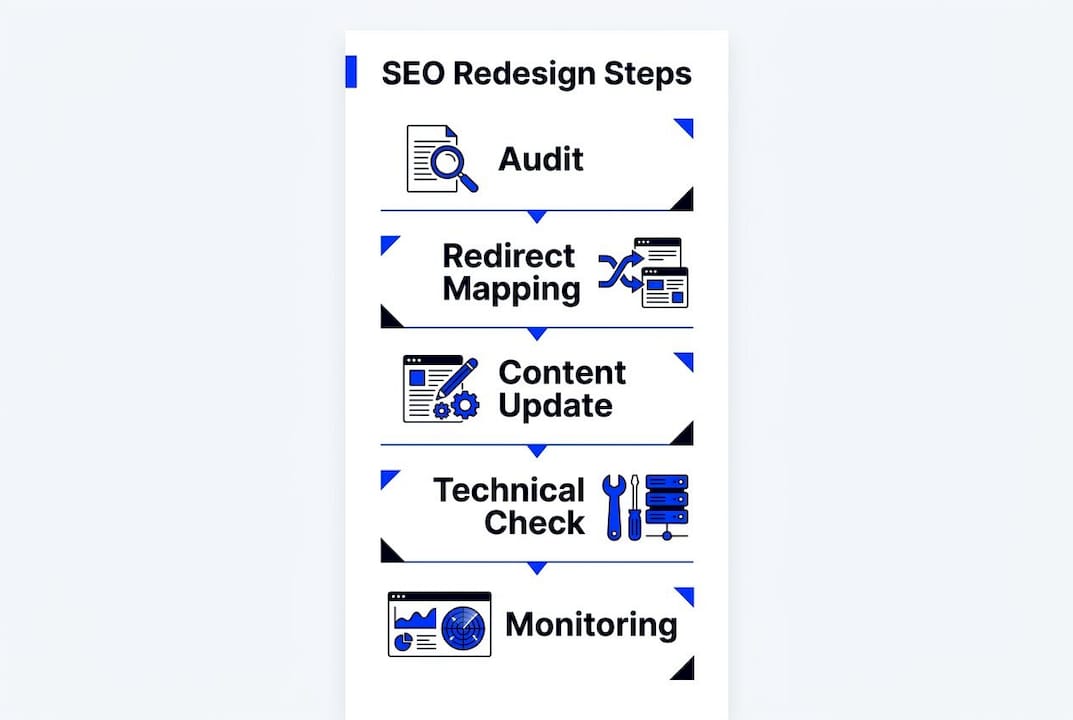
Website redesign SEO is the process of systematically protecting and improving your site's search rankings through every stage of a redesign. Without a structured approach, businesses can lose 20–70% of organic traffic within 30 days of launching a new site. That is not a minor dip. For Australian businesses investing in a revamp, that kind of loss can wipe out months of marketing gains overnight. Hasanoffcreative works with clients to integrate SEO from the first audit through to post-launch monitoring, which is exactly the process this article walks you through.
What are the essential SEO audits you must run before a website redesign?
The most common failure in a website overhaul SEO strategy is treating SEO as an afterthought. SEO work must begin weeks or months before design mockups are approved. Starting late means you have no baseline to protect, and no map of what you stand to lose.
A full pre-redesign audit covers four core areas:
- URL inventory: Crawl every live URL and record its HTTP status, title tag, meta description, word count, and inbound internal links. Tools like Screaming Frog produce this data in minutes.
- Performance baseline: Export 12 months of data from Google Analytics 4 and Google Search Console. Record which pages drive the most organic sessions, conversions, and revenue.
- Backlink profile: Map external backlinks to their specific URLs. This tells you which pages carry the most link equity and must be preserved or redirected with care.
- Keyword mapping: Document which keywords each page ranks for and at what position. A detailed keyword mapping document prevents keyword cannibalisation and orphaned high-value queries after the redesign.
The output of this audit is a master spreadsheet. Every URL gets a status: preserve, redirect, consolidate, or retire. High-traffic and high-converting pages go on a protected list. Nothing on that list changes without a deliberate decision.
Pro Tip: Export your Google Search Console performance report filtered to the last 16 months. Sort by clicks descending. The top 20 URLs on that list are your highest-priority pages to protect.
How do you plan URL architecture and 301 redirect mapping to avoid SEO damage?
URL architecture decisions made during a redesign have lasting consequences. The safest approach is to preserve existing URL structures wherever the new site allows. Every URL change requires a 301 redirect, and every redirect carries some risk of signal loss.
When you must change URLs, follow these principles:
- Map each old URL to its single most topically relevant new URL. Never redirect a page about commercial fit-out services to your homepage.
- Avoid redirect chains. Redirect chains degrade SEO performance and slow crawl performance. A redirect that passes through three URLs before reaching its destination loses ranking signals at each hop.
- Mass redirects to the homepage are a common mistake. Google treats these as soft 404s and drops the ranking signals entirely.
- Only finalise your redirect map after the new URL structure is locked. Launching without a comprehensive redirect map leads to loss of topical relevance and ranking drops.
Once the redirect map is complete, test every redirect on the staging environment before launch. Crawl the staging site with Screaming Frog and verify that each old URL returns a 301 status pointing to the correct destination. Update your XML sitemap to reflect only the new canonical URLs.
The decision framework for each URL is straightforward:
| URL status | Action | Condition |
|---|---|---|
| High traffic, same topic | Preserve URL | No structural reason to change |
| High traffic, URL must change | 301 redirect to equivalent | Topically matched destination exists |
| Low traffic, duplicate topic | Consolidate into stronger page | Content can be merged without loss |
| Low traffic, no ranking value | Retire | No backlinks, no conversions |
Pro Tip: Build your redirect map in a shared spreadsheet with columns for old URL, new URL, HTTP status confirmed, and sign-off. Treat it as a living document updated every time a URL decision changes during development.
What on-page SEO and content steps protect rankings on a redesigned site?
Content is where most redesigns quietly destroy their own rankings. Designers strip out body copy to create cleaner pages. Developers swap heading structures to match new templates. The result is pages that look better but rank worse.

Incremental content updates on high-performing pages reduce ranking volatility compared to drastic rewrites. The principle is simple: if a page ranks well, the content on it is doing something right. Preserve the information density, the primary H1, and the key supporting headings. Improve the writing, but do not gut the substance.
Schema markup deserves specific attention. FAQ schema, product schema, and breadcrumb schema all contribute to SERP visibility. These are often lost during template migrations. Audit every schema type on your current site and confirm each one carries across to the new templates.
Internal linking is another area that silently causes ranking losses more often than any other overlooked factor. When a redesign rebuilds navigation and page templates, internal links get removed, broken, or replaced with generic anchor text. Audit your internal link structure before launch and rebuild it deliberately, using descriptive anchor text that reflects the target page's primary keyword.
Mobile responsiveness and page speed are non-negotiable. Google uses mobile-first indexing, meaning the mobile version of your site is what gets crawled and ranked. Every new template must be tested on real devices, not just browser emulators.
Pro Tip: Run a side-by-side comparison of your top 10 pages in the old and new designs. Check that every H1, H2, and key paragraph is present in the new version before sign-off.
What technical SEO checks and launch-day practices reduce redesign risk?
Technical errors on launch day are the fastest way to destroy rankings. Most are preventable with a structured QA process run on the staging environment before a single line of code goes live.
- Check staging robots.txt. Leaving staging robots.txt set to "Disallow: /" causes immediate de-indexing upon launch. This is the single most common and most catastrophic technical error in site migrations.
- Audit canonical tags. Every page on staging should have a canonical tag pointing to its own URL. Misconfigured canonicals can consolidate ranking signals to the wrong pages.
- Test Core Web Vitals. Core Web Vitals regressions post-launch are a confirmed Google ranking factor. New design frameworks frequently increase Largest Contentful Paint (LCP) and Cumulative Layout Shift (CLS) scores. Test on staging and set a performance budget before launch.
- Run a full crawl on staging. Use Screaming Frog to confirm all redirects resolve correctly, no pages return 404 errors, and no orphaned pages exist.
- Verify analytics tracking. Confirm Google Analytics 4 and Google Search Console are firing correctly on every page template before launch.
Avoid launching on a Friday. The Safe Launch Window principle recommends mid-week launches so your team is fully available to identify and fix issues in the critical first 48 hours. A Friday launch means a weekend of unmonitored problems.
Pro Tip: Create a launch-day checklist with a named owner for each item. Run through it in order, with sign-off required before DNS is switched. No exceptions.
How do you monitor and recover SEO performance after a website redesign?
Post-launch monitoring is not optional. Post-launch SEO monitoring for at least 90 days is necessary to identify and resolve ranking issues after a redesign. Search engines take weeks to re-crawl and re-evaluate a redesigned site, and problems that are invisible on day one can surface on day 30.
Structure your monitoring around three milestones:
- Days 1–30: Check Google Search Console daily for crawl errors, indexation drops, and redirect issues. Compare organic sessions to the pre-launch baseline. Investigate any page that has dropped more than 20% in clicks.
- Days 31–60: Analyse keyword ranking movements. Identify pages that have lost positions and cross-reference with content, internal linking, and technical changes made during the redesign.
- Days 61–90: Assess conversion rates and revenue against pre-launch benchmarks. Make data-driven content updates, fix any remaining internal linking gaps, and tune Core Web Vitals where scores have regressed.
Beyond 90 days, the focus shifts to growth. Build a content calendar that targets new keywords aligned with your redesigned site architecture. Invest in Expertise, Authoritativeness, and Trustworthiness (E-E-A-T) signals by adding author credentials, case studies, and detailed service pages. Ongoing SEO is what turns a successful migration into a traffic growth story.
Key takeaways
A website redesign without integrated SEO planning causes measurable, preventable traffic loss. The businesses that protect and grow their rankings treat SEO as a parallel process, not a post-launch task.
| Point | Details |
|---|---|
| Pre-launch audit is non-negotiable | Document every URL, keyword ranking, and backlink before any design work begins. |
| Redirect mapping prevents signal loss | Map every changed URL to a topically matched destination with no chains or homepage dumps. |
| Content preservation protects rankings | Keep H1s, schema markup, and information density intact on high-performing pages. |
| Technical QA stops launch-day disasters | Fix staging robots.txt, canonical tags, and Core Web Vitals before DNS switches. |
| 90-day monitoring catches hidden issues | Track crawl errors, ranking movements, and conversions weekly for three months post-launch. |
What I have learned from SEO redesign projects at Hasanoffcreative
The pattern I see most often is this: a business spends months on a beautiful new design, then calls us two weeks before launch asking us to "check the SEO." By that point, URL structures are locked, content has been rewritten, and the redirect map does not exist. We can still help, but the risk is significantly higher than if we had been involved from day one.
The issues that cause the most damage are rarely dramatic. They are quiet failures. A template regression strips the FAQ schema from 40 product pages. The staging robots.txt gets pushed to production. Internal links that took two years to build get replaced with generic "read more" anchor text. None of these look like disasters in a design review. They all look like disasters in Google Search Console three weeks later.
My recommendation is to treat SEO as a design constraint, not a post-production task. The same way you would not finalise a site without testing it on mobile, you should not finalise a URL structure without a redirect map, or approve a template without checking it preserves the existing heading hierarchy. These are not extra steps. They are part of building a site that actually performs.
The businesses that get this right come out of a redesign with stronger rankings than they started with. The ones that get it wrong spend the next six months trying to recover traffic they never needed to lose.
— Hasanoff
Hasanoffcreative builds redesigns that protect your rankings
A new website should grow your business, not cost you the search traffic you have already earned.
Hasanoffcreative is a Sydney-based web design studio that integrates SEO into every phase of the redesign process, from the initial audit through to post-launch monitoring. Clients like Lumi Studio and Astra Dining have seen increased enquiries and stronger brand presence after their redesigns, precisely because SEO was built in from the start, not bolted on at the end. If you are planning a website overhaul and want to protect your organic traffic while improving your search performance, get in touch with Hasanoffcreative before the design brief is written.
FAQ
What is website redesign SEO?
Website redesign SEO is the process of integrating search engine optimisation into every phase of a site redesign to protect existing rankings and improve search performance. It covers pre-launch audits, redirect mapping, content preservation, technical QA, and post-launch monitoring.
How much traffic can you lose from a poorly planned redesign?
Sites without a structured SEO process can lose between 20% and 70% of organic traffic within 30 days of launch. The losses depend on how many URLs changed, how redirects were handled, and whether content was preserved.
How long does it take to recover SEO after a redesign?
Recovery timelines vary, but ranking and indexation stabilise over weeks to months after a redesign. Monitoring for at least 90 days post-launch gives you the data needed to identify and fix issues before they compound.
What is the most common technical SEO mistake on launch day?
Leaving the staging environment's robots.txt file set to block all crawlers is the most common and most damaging technical error. If this file is not corrected before launch, the site disappears from Google's index within days.
Should you change your URL structure during a redesign?
Preserve existing URLs wherever possible. Every URL change requires a 301 redirect, and every redirect carries some risk of ranking signal loss. Change URLs only when there is a clear structural or topical reason to do so.