
Website redesign cost is the total expenditure required to update or rebuild a business website, covering design, development, content, and SEO work. For Australian small to mid-sized businesses, that figure typically falls between $15,000 and $80,000, with the median project landing around $36,500. The final number depends on scope, platform choice, and how much legacy work needs untangling. Get the scope wrong and you will either overspend on features you do not need or underspend and face a rebuild in 18 months.
What factors influence the cost of a website redesign?
Website redesign pricing is driven by scope more than any other single variable. A five-page brochure site refresh and a 200-page eCommerce migration are both called "redesigns," but they share almost nothing in terms of effort or cost.
The main cost drivers are:
- Scope of work. A visual refresh updates colours, fonts, and imagery without touching the backend. A full redesign rebuilds page templates, navigation, and user flows. A rebuild starts from scratch. Each step up roughly doubles the budget.
- Platform decisions. Staying on the same platform (WordPress to WordPress, for example) costs significantly less than migrating. Replatforming projects cost 1.5× more than same-platform redesigns because data mapping, plugin replacement, and QA testing all add hours.
- Design complexity. Custom UX and UI work, bespoke animations, and interactive features cost more than template-based designs. The more unique the experience, the more design and development hours are required.
- Content and SEO. Auditing existing content, writing new copy, and mapping 301 redirects all add to the bill. These tasks are frequently underestimated at the quoting stage.
- Project management and revisions. Poorly defined briefs lead to revision cycles that blow out timelines and budgets. Stakeholder alignment before work begins is not optional.
Pro Tip: Ask every vendor to separate design, development, content, and SEO costs in their quote. A single lump-sum figure makes it impossible to compare proposals or identify where budget is going.
How much does a website redesign cost in Australia?
Most Australian businesses pay somewhere in the $15,000–$80,000 range for a professional redesign. That is a wide band, so it helps to match your project type to a realistic tier.

| Project type | Typical cost range | Timeline |
|---|---|---|
| Visual refresh | $5,000–$15,000 | 2–4 weeks |
| Mid-level redesign | $15,000–$50,000 | 6–12 weeks |
| Full rebuild or platform migration | $50,000–$80,000+ | 8–20 weeks |
| Enterprise or eCommerce | $80,000–$150,000+ | 12–20+ weeks |
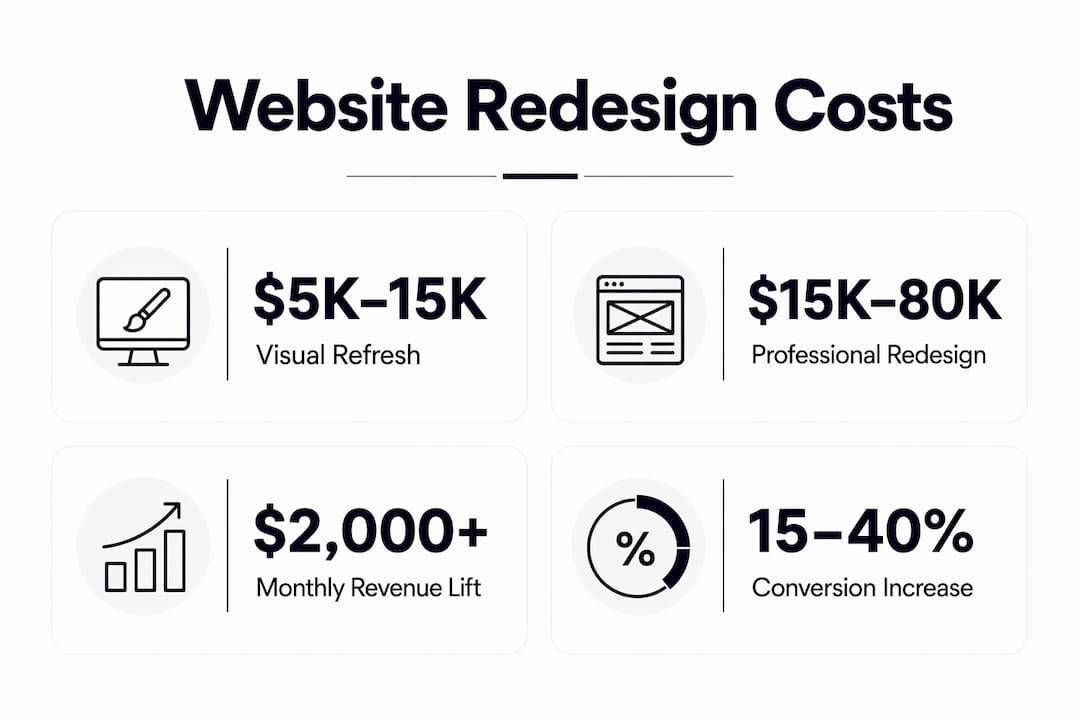
A visual refresh updates the look without touching the backend. It suits businesses whose site structure and content are sound but whose brand has evolved. A mid-level redesign rebuilds templates and improves user flows, which is the most common project type for growing businesses. A full rebuild or platform migration is appropriate when the existing codebase is too outdated to work with efficiently.
Freelancers typically charge less than agencies, but the gap narrows on complex projects. A freelancer may quote $12,000 for a mid-level redesign, but without a project manager, SEO specialist, and QA tester built into the team, those roles fall back on you. Agencies bundle that expertise into their rate, which is why design-only projects range $33,000–$76,000 with full development pushing $50,000–$150,000 or more.
Well-executed redesigns improve conversion rates by 15–40%. A $36,000 redesign that lifts monthly revenue by $2,000 pays for itself in 18 months. That framing changes how you should think about the budget: it is an investment with a measurable return, not a sunk cost.
Pro Tip: If a quote sits well outside the $15,000–$80,000 range without a clear scope justification, ask the vendor to explain what is driving the number. Unusually low quotes often exclude SEO, content, or QA work that will surface later as extras.
What hidden costs often blow out website redesign budgets?
Redesigns consistently cost 15–25% more than new builds because of work that is invisible at the quoting stage. Knowing where those costs hide lets you budget for them before they become surprises.
-
Content migration. Moving 50 pages takes 20–40 hours of professional time. Blog-heavy sites add $1,000–$3,000 in migration costs alone. Automated migration tools fix roughly 70% of content correctly, meaning 30% still requires manual review and correction.
-
SEO preservation. Every URL that changes during a redesign needs a 301 redirect. Miss one and you lose the search ranking that URL had built. Traffic drops of 30–60% are common after poorly managed migrations. Proper redirect mapping, canonical tag auditing, and post-launch monitoring all cost time and money.
-
Legacy code cleanup. Older sites accumulate technical debt: outdated plugins, deprecated functions, and custom code written by developers who are long gone. Cleaning that up before building on top of it is non-negotiable, and it adds hours that rarely appear in an initial quote.
-
Stakeholder revisions. Every round of revisions beyond the agreed scope adds cost. Businesses with multiple decision-makers, franchisees, or board-level sign-off requirements routinely add 20–30% to their project timeline through revision cycles alone.
-
Ongoing ownership costs. The redesign is not the end of the spend. Annual maintenance runs 15–30% of the initial redesign cost, covering hosting, security updates, plugin licences, and performance monitoring. Over three years, total cost of ownership is roughly double the upfront redesign figure.
Stakeholder alignment and SEO continuity are the primary predictors of redesign success or failure. Design quality matters, but a beautiful site that loses 40% of its organic traffic on launch day is a costly mistake.
How can business owners budget effectively for a website redesign?
Effective budgeting starts with knowing what problem you are actually solving. A business that needs more leads from organic search has different requirements to one that needs a faster checkout flow. Confusing the two leads to overspending on the wrong things.
- Define the business goal first. Write down the one or two outcomes the redesign must deliver: more enquiries, lower bounce rate, faster load times. Every budget decision should trace back to those goals.
- Classify your project correctly. A refresh and a rebuild are distinct projects. Knowing which one you need before you approach vendors saves weeks of misaligned quoting. If your structure and content are sound, a refresh may be all you need.
- Request itemised quotes. Ask vendors to break costs into design, development, content, SEO, and project management. This makes comparison meaningful and reveals what each vendor is and is not including.
- Plan your content timeline separately. Content is almost always the bottleneck. Brief your copywriter or internal team at the same time you brief the design agency, not after design is complete.
- Build a 15–20% contingency into your budget. Unexpected technical debt, extra revision rounds, and scope changes are normal. Budget for them upfront rather than negotiating mid-project.
Pro Tip: Ask vendors how they handle scope changes. A fixed-price contract with a clear change-order process protects both parties. Vague "we'll figure it out" answers are a warning sign.
Key takeaways
Website redesign cost in Australia typically ranges from $15,000 to $80,000, with the median project around $36,500, and the final figure depends on scope, platform choice, content volume, and SEO complexity.
| Point | Details |
|---|---|
| Typical cost range | Most Australian small to mid-sized businesses spend $15,000–$80,000 on a professional redesign. |
| Hidden costs add up | Redesigns cost 15–25% more than new builds due to content migration, SEO work, and legacy code cleanup. |
| Ongoing ownership matters | Annual maintenance runs 15–30% of the upfront cost, roughly doubling total spend over three years. |
| Classify before you quote | Knowing whether you need a refresh, redesign, or rebuild prevents misaligned vendor quotes and wasted budget. |
| ROI is measurable | Well-executed redesigns improve conversion rates by 15–40%, making the investment recoverable within months. |
The real cost of getting a redesign wrong
Most business owners I speak with come to a redesign conversation focused on price. That is understandable. But in my experience, the businesses that get the best outcomes focus on scope clarity first and price second.
I have seen projects quoted at $20,000 that should have been $45,000. The low quote looked attractive until the client discovered that SEO migration, content writing, and QA testing were all excluded. By the time those gaps were filled with extras, the project cost more than a properly scoped quote would have. The lesson is not that cheap is bad. It is that an incomplete scope produces an incomplete quote.
The other pattern I see regularly is businesses choosing a refresh when they actually need a rebuild. A refresh on a structurally broken site is like repainting a house with cracked foundations. The result looks better for six months, then the underlying problems resurface. A proper discovery phase, where you audit the existing site before scoping the work, prevents that mistake.
The businesses that get the most from their redesign investment are the ones that treat it like a business project, not a creative exercise. They set measurable goals, hold vendors accountable to those goals, and plan for content and SEO from day one. That approach costs no more than a poorly planned redesign. It just delivers a different result.
— Hasanoff
Hasanoffcreative: custom web design built around your goals
Hasanoffcreative is a Sydney-based web design studio that builds high-performing websites for businesses that need measurable results, not just a fresh look. Every project starts with a discovery phase to align scope, goals, and budget before a single pixel is designed.
Clients like Lumi Studio and Astra Dining have seen increased enquiries and stronger brand presence after their redesigns, because the work was scoped to solve specific business problems. Whether you need a visual refresh or a full platform migration, Hasanoffcreative builds to a brief that connects design decisions to conversion outcomes. Get in touch for a detailed cost estimate tailored to your project scope and goals.
FAQ
How much does a website redesign cost in Australia?
Most Australian small to mid-sized businesses pay between $15,000 and $80,000 for a professional website redesign, with the median project costing around $36,500. The final figure depends on scope, platform, and content volume.
What is the difference between a website refresh and a full redesign?
A refresh updates visuals such as colours, fonts, and imagery without changing the site structure or backend. A full redesign rebuilds page templates, navigation, and user flows, and costs significantly more.
Why do website redesigns cost more than building a new site?
Redesigns cost 15–25% more than new builds because of hidden work including content migration, SEO redirect mapping, and legacy code cleanup that new builds do not require.
How long does a website redesign take?
Timelines range from 2–4 weeks for a visual refresh to 8–20 weeks for a full redesign or platform migration. Complex eCommerce or enterprise projects can extend beyond 20 weeks.
What ongoing costs should I budget for after a redesign?
Annual maintenance typically runs 15–30% of the initial redesign cost, covering hosting, security, plugin licences, and performance updates. Over three years, total ownership cost is roughly double the upfront investment.